Robot teleoperation kits: SO-101, GELLO and the ALOHA line compared
A leader arm is the simplest teleoperation controller and the one that records the cleanest data. The kits differ by a factor of a hundred in price. This guide sets out what the money buys.
Contents
Teams that search for a teleoperation kit are usually about to collect their first demonstrations and want something that works on the day it arrives. The difficulty is that "kit" covers a $230 bag of servos and a $24,000 station with a touchscreen. Both use the same principle, and both produce the same kind of data.
How a leader-follower rig works
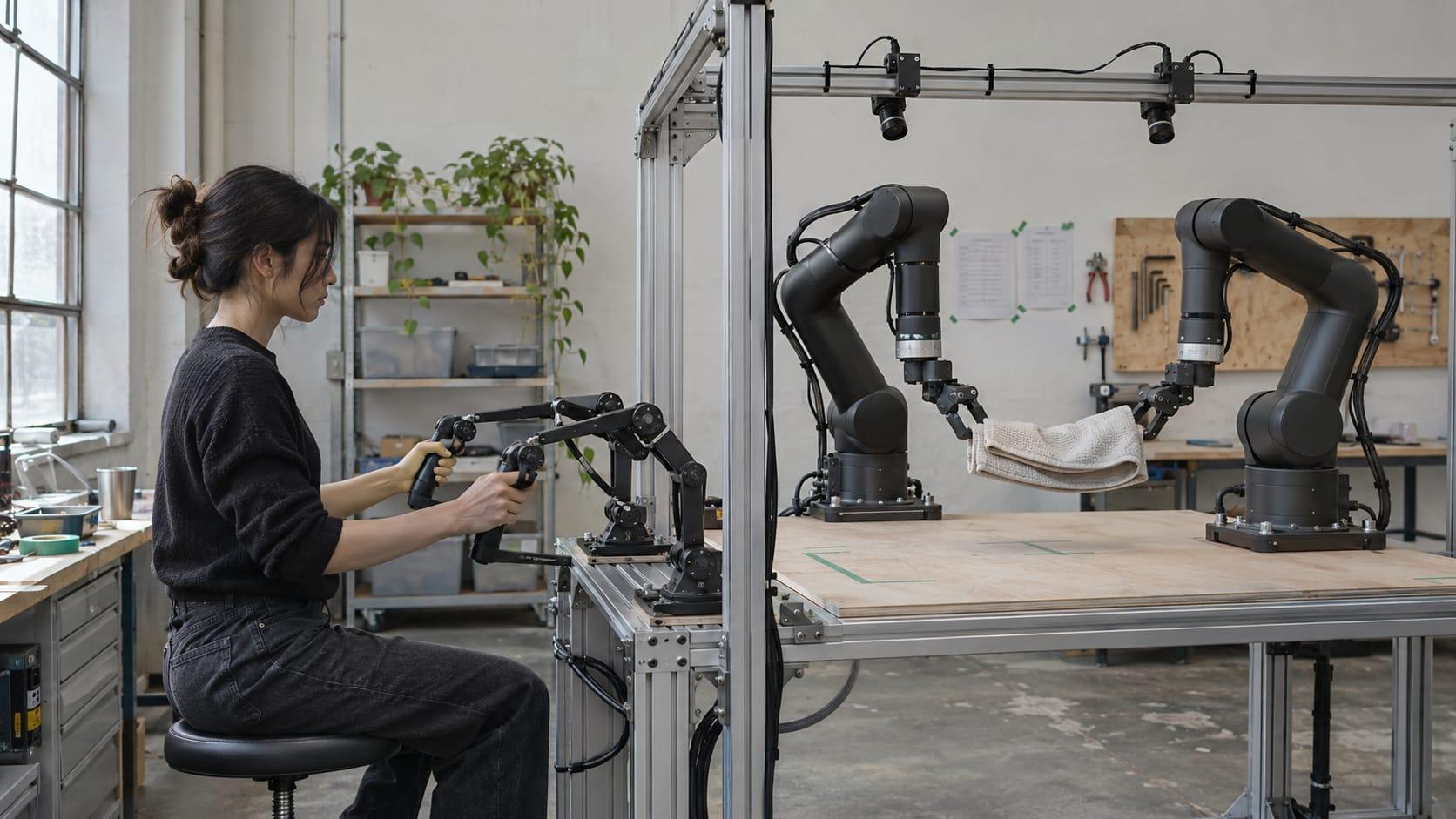
The operator holds a small arm, the leader, that has the same joints as the robot. Sensors in the leader read each joint angle and the robot, the follower, moves its own joints to match. In LeRobot the whole loop is two lines: read an action from the leader, send it to the follower1.
The appeal is in what gets recorded. The action is a set of joint positions, which is what the robot's controller consumes. Nothing has to be converted from a hand pose. ALOHA, the system that made this design standard, trained policies that predict joint positions directly at 50 Hz and reached 80 to 90% success on six fine bimanual tasks with about ten minutes of demonstrations each23. In a user study by GELLO's authors, 12 participants completed five tasks faster with a leader arm than with VR controllers or 3D mice4.
The limit is the same property. A leader has the kinematics of one robot. A different arm needs a different leader.
The kits compared
| Option | Published price | Degrees of freedom | What it records | Supported robots | Open design | Operators included |
|---|---|---|---|---|---|---|
| 1. SO-101 leader and follower arms | Yes. $229.88 parts, both arms | 5 joints plus gripper | Joint positions and camera video | SO-101 follower | Yes. Hardware and software | No. You hire and train |
| 2. GELLO | Yes. Under $300 in parts (authors) | Matches the target arm’s joints | Joint positions | Franka, UR5, xArm | Yes. Hardware and software | No. You hire and train |
| 3. Trossen AI kits and Glide | Yes. $23,995.95 (Stationary AI) | Not stated on the page | Joint positions, four camera streams | WidowX AI followers; Glide also UR3e | Partly. Open SDK; commercial hardware | No. You hire and train |
SO-101: the entry point
The SO-101 was designed by TheRobotStudio with Hugging Face as the successor to the SO-100, with improved wiring and easier assembly5. The bill of materials for a leader and follower is $229.88 in the United States and €226.30 in the European Union; a follower alone is $121.945. Each arm has six STS3215 servos. The follower's all use a 1/345 gear ratio, while the leader mixes three ratios so that it holds its own weight and still moves under light force6. Seeed Studio describes the arm as 5+1 degrees of freedom with a 500 g payload and sells a motor kit for both arms at $249.90, without printed parts7. Profile.
GELLO: a leader for the arm you own
GELLO is a design, not a kit in a box. Its authors at UC Berkeley publish the parts and software to build a scaled replica of a Franka, a UR5 or an xArm from 3D-printed parts and off-the-shelf motors, for less than $300 and about 30 minutes of assembly by their account48. It is the low-cost route for a lab that already has a research arm. Profile.
The ALOHA line: complete bimanual stations
ALOHA pairs two leaders with two followers and four cameras, two fixed and two on the wrists, each streaming at 480 by 6402. Its authors describe it as buildable on a $20,000 budget2. ALOHA 2 kept the layout and replaced the grippers, the gravity compensation, the frame and the cameras, and its team open-sourced all hardware designs9.
Trossen Robotics sold the kit version. That product, Aloha Stationary, is now marked discontinued, and the successor line is Trossen AI10. The Stationary AI kit is listed at $23,995.95 and includes two leader-follower WidowX AI arm pairs, four Intel RealSense D405 cameras, a 10-inch touchscreen and the frame, with an average production time of two to three weeks11. A single WidowX AI arm is $4,545.95 and the Mobile AI platform is $33,695.9512. Trossen states that the line works with LeRobot for data collection12. Profile.
Trossen also sells a leader on its own. Glide has passive joints with encoders and a spring balance and no motors, so nothing resists the operator's hand. It costs $2,495 per arm, or $6,995 for a left and right pair with the Cockpit station, and drives kinematically similar arms in joint space and a UR3e in Cartesian space13.
What the kit does not include
Three things are missing from every box.
Recording discipline. LeRobot's recorder defaults to 60-second episodes with a 60-second reset, 50 episodes per run1. At those defaults one station yields at most 30 episodes an hour, by our arithmetic, and fewer once failed attempts are re-recorded. The same documentation warns that a recording loop that falls behind its target rate still stamps frames as if it had kept up, so the dataset claims a speed the robot never ran at1.
A task protocol. The documentation advises fixed cameras, consistent grasping and adding variation slowly1. Those are instructions for people, and someone has to write and enforce them.
The people. A bimanual station needs an operator for every hour it runs. The operator cost guide sets out what that adds.
How to choose
- Start from the robot that will run the policy. If it is the SO-101, buy the pair. If it is a Franka, UR5 or xArm, build GELLO. If the project needs two arms and has no robot yet, price a station.
- Count the arms and cameras the task needs. One arm and two cameras is a different budget from four arms and four cameras.
- Decide who builds and maintains it. Open designs save money and cost engineering time. A commercial kit arrives assembled, with a production lead time.
- Record 50 episodes of one task and train. Confirm the files load and the replay reproduces the motion before buying a second station.
- Plan the operator hours before scaling. A second station is useful only with a second trained operator.
The end state is a station that records clean joint-space episodes at a known hourly rate, with a protocol on paper and a named person responsible for each shift.
Questions buyers ask
What is a robot teleoperation kit?
A matched set of hardware for controlling a robot by hand and recording it. A leader-follower kit contains one or two small leader arms, the follower arms that copy them, cameras, a frame and software. The SO-101 is the smallest example and Trossen's Stationary AI kit is a complete bimanual station.
How much does an ALOHA kit cost?
The ALOHA authors describe a self-built system on a $20,000 budget. Trossen Robotics, which sold the kit version, has discontinued Aloha Stationary and lists its successor, the Stationary AI kit with four arms and four cameras, at $23,995.95. The mobile version is $33,695.95.
Is the SO-101 good enough to train a robot policy?
For learning the pipeline and training a first policy on the SO-101 itself, yes. LeRobot documents teleoperation, recording, replay and training on it, and suggests at least 50 episodes for a first task. The data does not transfer to a different production arm.
Can a leader arm control a robot that is somewhere else?
In principle, since the leader only sends joint positions over a connection. In practice the operator also needs camera views and a round trip short enough for direct control, roughly under 100 to 150 milliseconds for manipulation to feel natural.
Sources
- Imitation learning on real-world robots: teleoperate, record, train. Hugging Face LeRobot documentation. Accessed 11 Nov 2026.
- ALOHA: a low-cost open-source hardware system for bimanual teleoperation. Zhao, Kumar, Levine and Finn. Accessed 11 Nov 2026.
- Learning Fine-Grained Bimanual Manipulation with Low-Cost Hardware. arXiv, 23 Apr 2023. Accessed 11 Nov 2026.
- GELLO: a general, low-cost and intuitive teleoperation framework for robot manipulators. Wu, Shentu, Yi, Lin and Abbeel, UC Berkeley. Accessed 11 Nov 2026.
- SO-ARM100: standard open arms SO-100 and SO-101 (bill of materials). TheRobotStudio on GitHub. Accessed 11 Nov 2026.
- SO-101 assembly, motor setup and calibration. Hugging Face LeRobot documentation. Accessed 11 Nov 2026.
- SO-101 servo motor kit, LeRobot compatible. Seeed Studio. Accessed 11 Nov 2026.
- GELLO: A General, Low-Cost, and Intuitive Teleoperation Framework for Robot Manipulators. arXiv, 22 Sep 2023. Accessed 11 Nov 2026.
- ALOHA 2: an enhanced low-cost hardware for bimanual teleoperation. ALOHA 2 Team. Accessed 11 Nov 2026.
- Aloha Stationary (discontinued). Trossen Robotics. Accessed 11 Nov 2026.
- Stationary AI kit. Trossen Robotics. Accessed 11 Nov 2026.
- Trossen AI: Stationary, Mobile, Solo and WidowX AI. Trossen Robotics. Accessed 11 Nov 2026.
- Glide leader arm and Cockpit station. Trossen Robotics. Accessed 11 Nov 2026.
Updated 11 Nov 2026: First published.