VR teleoperation for robots: headsets, software and limits
A consumer headset is the cheapest way to drive many different robots with one device. It records poses, not joints, and it asks a great deal of the person wearing it.
Contents
The question behind a search for VR teleoperation is usually whether a few hundred dollars of consumer hardware can stand in for a custom rig. For many robots it can. What the headset saves in hardware it moves into software and into the operator's stamina, and both deserve a look before the order is placed.
What a headset captures
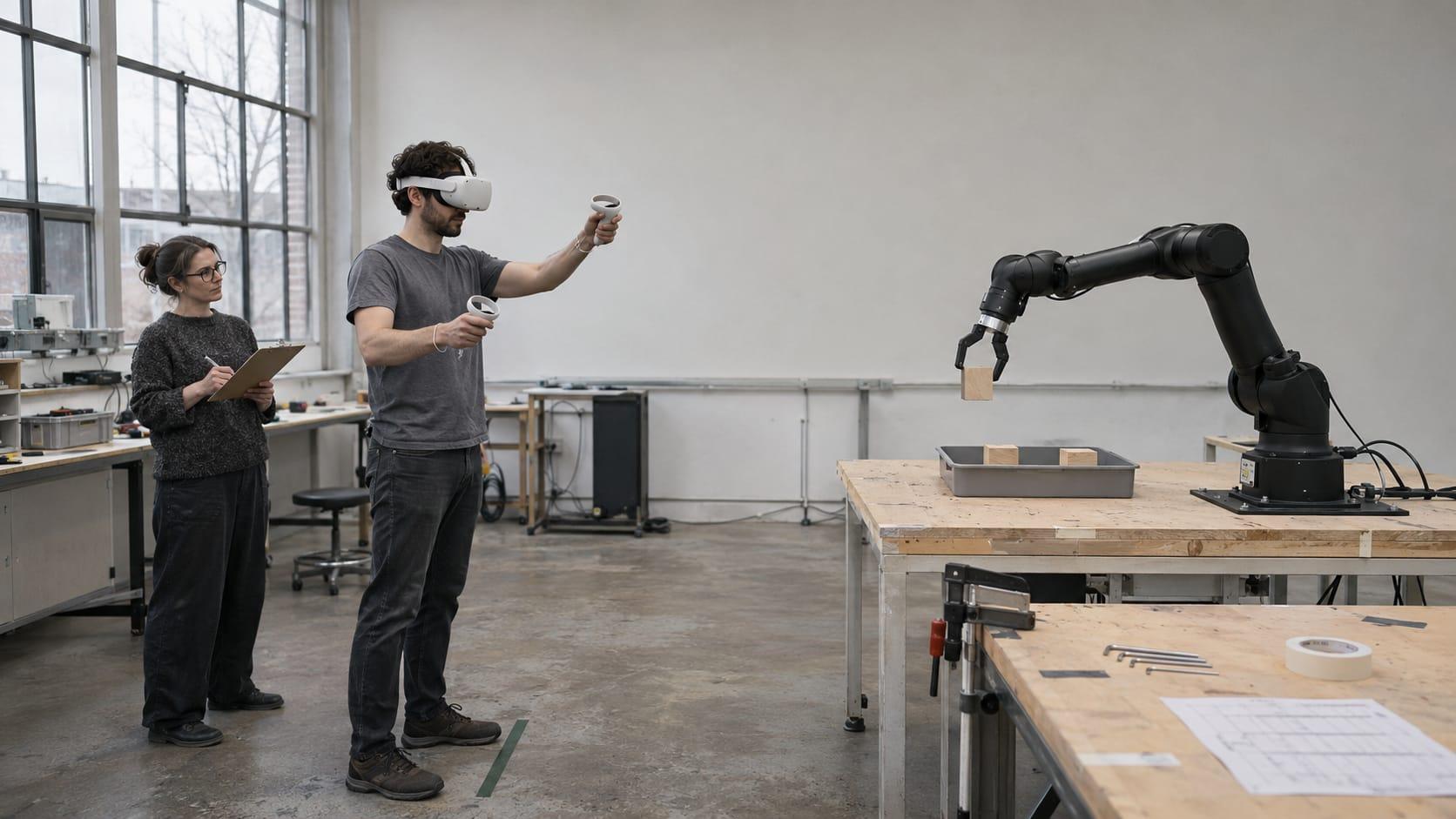
A VR headset tracks the pose of the operator's head, and its controllers track the poses of the wrists1. Headsets with hand tracking, such as Apple Vision Pro, also report finger poses without anything in the hand2. The operator sees through the robot's cameras, in some systems in stereo with the view following the head3.
What is recorded is therefore a pose, not a joint angle. Software has to work out which joint positions put the robot's hand where the operator's hand is. LeRobot's phone teleoperation, which uses the same principle, shows the steps: the device pose becomes a target for the gripper, a safety stage clamps it to a workspace and limits jumps, and an inverse-kinematics stage turns it into joint positions4. A leader arm skips all of that, which is one reason GELLO's authors measured faster task completion with a leader than with VR controllers5.
The advantage is generality. One headset can drive an arm today and a humanoid's upper body tomorrow. RoboPilots' reference page on humanoids describes an Apple Vision Pro or a Meta Quest streaming head and hand poses as the default setup for upper-body manipulation data6.
The headsets
| Option | Published price | Degrees of freedom | What it records | Supported robots | Open design | Operators included |
|---|---|---|---|---|---|---|
| 1. Meta Quest 3 | Yes. $600 (512 GB, reported) | Head and two wrist poses, or hand tracking | Head and wrist or hand poses | Unitree humanoids named; Franka arms in DROID (Quest 2) | Partly. Closed device; open software exists | No. You hire and train |
| 2. Apple Vision Pro | Yes. From $3,499 | Head, wrists and fingers by camera | Head, wrist and finger poses | Dexterous hands (Bunny-VisionPro); Unitree humanoids | Partly. Closed device; open software exists | No. You hire and train |
Meta Quest. UploadVR reported on 16 April 2026 that Meta raised the 512 GB Quest 3 from $500 to $600 and the 128 GB Quest 3S from $300 to $3507. The line has the longest record in robot data. The DROID dataset, 76,000 trajectories and 350 hours across 564 scenes, was collected with an Oculus Quest 2 headset and its controllers driving a Franka Panda arm8. Profile.
Apple Vision Pro. Apple's price starts at $3,4999. Its use in robotics rests on hand tracking. Bunny-VisionPro converts hand poses from the headset into commands for two dexterous robot hands in real time, and adds low-cost vibration actuators because camera tracking alone gives the operator no sense of touch2. Profile.
The software that makes it work
- Unitree xr_teleoperate. Open software for Unitree's humanoids. It names Apple Vision Pro, PICO 4 Ultra Enterprise and Meta Quest 3 as example devices, offers hand-tracking and controller modes, supports the G1 and H1 families with several grippers and dexterous hands, and records episodes for imitation learning10.
- Open-TeleVision. An open-source system with stereo visual feedback that mirrors the operator's arm and hand movements on the robot, shown on two humanoids and with operator and robot about 3,000 miles apart3.
- Bunny-VisionPro. Bimanual dexterous-hand control from Apple Vision Pro, with haptic feedback2.
- LeRobot phone teleoperation. Not a headset, but the same idea at no hardware cost: an iPhone through the HEBI Mobile I/O app or an Android phone through WebXR4.
Where VR falls short
Delay. A headset is often chosen so that the operator can be somewhere else. Then the network matters. A round trip under roughly 100 to 150 milliseconds feels close to natural for direct manipulation; above about 300 milliseconds operators switch to moving and waiting11. RoboPilots' free latency calculator estimates the round trip between two cities and the control mode it supports12.
The operator's body. Tesla's 2024 listing for Optimus data collection operators, as reported, required walking more than seven hours a day in a motion-capture suit and VR headset, in one of three eight-hour shifts13. Headset work is a physical job and has to be staffed and scheduled as one.
Touch. A controller or a tracked bare hand feels nothing when the robot makes contact. Research systems add vibration2; gloves with force feedback are the fuller answer and are covered in the guide to gloves and exoskeletons.
A sensible first setup
- Check that software exists for your robot and headset together. The headset is the cheap part. An unsupported pairing is an engineering project.
- Buy one headset and measure the loop. Record the round-trip delay where the robot works, with the cameras and encoder you will use.
- Record a small task and replay it on the robot. A replay that reproduces the motion shows that the pose conversion is sound.
- Set shift lengths from what operators can sustain. Then calculate how many operators the data plan needs.
- Add stations as operators are trained, not before. The operator cost guide covers the wage and training side.
The end state is a headset station where a trained operator works a sustainable shift, the delay is known, and each session lands as episodes the training code reads.
Questions buyers ask
Which VR headset is best for robot teleoperation?
For controller-based control of arms on a budget, the Meta Quest line, which was used to collect the DROID dataset and was reported at $600 for the 512 GB Quest 3 in April 2026. For bare-hand control of multi-fingered robot hands, Apple Vision Pro, from $3,499. Unitree's software for its humanoids supports both.
Can you control a humanoid robot with VR?
Yes, for the upper body. Unitree's open xr_teleoperate software drives the arms and hands of its G1 and H1 humanoids from an Apple Vision Pro, a PICO 4 Ultra Enterprise or a Meta Quest 3. Walking is usually steered separately while the robot's own controller keeps balance.
Does VR teleoperation work over the internet?
It can. The Open-TeleVision authors show an operator and a robot about 3,000 miles apart. Whether direct control is comfortable depends on round-trip delay. Under roughly 100 to 150 milliseconds feels close to natural for manipulation, and above about 300 milliseconds continuous control becomes hard.
Can a phone replace a VR headset for teleoperation?
For a simple arm, yes. LeRobot supports iPhones through the HEBI Mobile I/O app and Android phones through WebXR. The phone's pose becomes the gripper's target, with a hold-to-move button as a safety switch.
Sources
- How to collect teleoperation data for robot learning. RoboPilots, 9 Oct 2026. Accessed 11 Nov 2026.
- Bunny-VisionPro: real-time bimanual dexterous teleoperation for imitation learning. Ding et al., University of Hong Kong and UC San Diego. Accessed 11 Nov 2026.
- Open-TeleVision: teleoperation with immersive active visual feedback. Cheng, Li, Yang, Yang and Wang (CoRL 2024). Accessed 11 Nov 2026.
- Phone teleoperation. Hugging Face LeRobot documentation. Accessed 11 Nov 2026.
- GELLO: a general, low-cost and intuitive teleoperation framework for robot manipulators. Wu, Shentu, Yi, Lin and Abbeel, UC Berkeley. Accessed 11 Nov 2026.
- Humanoid robot teleoperation, model by model. RoboPilots, 16 Oct 2026. Accessed 11 Nov 2026.
- Meta raises Quest 3 and Quest 3S prices. UploadVR, 16 Apr 2026. Accessed 11 Nov 2026.
- DROID: a large-scale in-the-wild robot manipulation dataset. DROID dataset team. Accessed 11 Nov 2026.
- Apple Vision Pro upgraded with the M5 chip and Dual Knit Band. Apple Newsroom, 15 Oct 2025. Accessed 11 Nov 2026.
- xr_teleoperate: teleoperation of Unitree humanoid robots with XR devices. Unitree Robotics on GitHub. Accessed 11 Nov 2026.
- Teleoperation latency: how much delay each robot task tolerates. RoboPilots, 31 Oct 2026. Accessed 11 Nov 2026.
- Teleoperation latency calculator. RoboPilots, 31 Oct 2026. Accessed 11 Nov 2026.
- Tesla will pay up to $48 an hour to capture your movements. Decrypt, 19 Aug 2024. Accessed 11 Nov 2026.
Updated 11 Nov 2026: First published.