Teleoperation gloves and exoskeletons: what they capture and cost
Robot hands with fingers need controllers with fingers. Commercial gloves are sold by quote, open designs cost a few hundred dollars to build, and the two groups suit different teams.
Contents
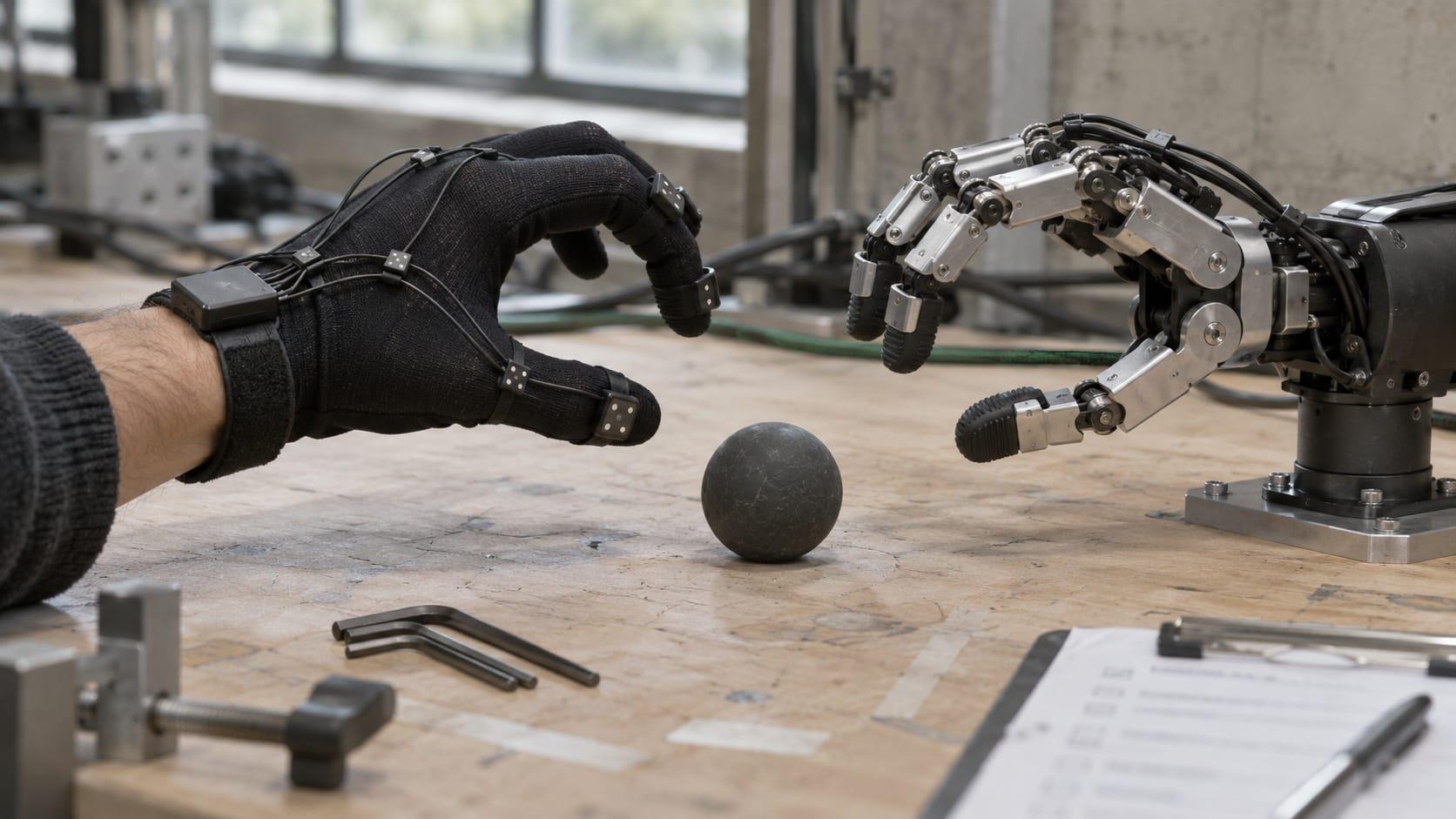
A team that buys a dexterous robot hand finds that its existing controller no longer fits. A leader arm with a trigger opens and closes a gripper; it cannot place five fingers. The search for a glove then runs into quote-only prices on one side and research papers on the other, with little that compares the two.
Why hands change the problem
The Shadow Dexterous Hand has 20 degrees of freedom, 24 movements and 120 sensors, by its maker's description1. Driving it means measuring the operator's finger joints continuously and mapping them to a hand with different proportions. A glove does the measuring. It does not track where the hand is in space, so it is paired with something that does: a headset, an arm tracker or an exoskeleton.
The other difference is touch. An operator closing a robot hand on an object sees contact on a screen and feels nothing, unless the glove pushes back.
Commercial gloves
MANUS Metagloves Pro. Electromagnetic-field tracking, 25 degrees of freedom of a full anatomical hand model, swappable batteries and ROS 2 among the listed integrations, by the maker's page. The price is by quote, and haptic feedback is a separate model2. The older Quantum Metagloves, now marked legacy and end-of-life, list a 120 Hz sample rate and signal latency of 7.5 milliseconds or less3. Profile.
HaptX Gloves G1. The maker lists 135 tactile actuators per hand, up to 8 pounds of force feedback per finger, 36 tracked degrees of freedom per glove and a ROS node for ROS 1 and ROS 2. No price is shown; the page directs buyers to sales4.
Shadow Teleoperation System. A complete system rather than a glove: Shadow's Dexterous Hands on arms and stands, with a choice of the Shadow Glove, a HaptX glove with Shadow tactile fingertips or MANUS Metagloves Pro Haptic. Shadow describes it as designed for the nuclear, pharmaceutical, maintenance and research sectors and operable "from the next room, or across continents". No price or latency figure is published1.
Open designs
| Option | Published price | Degrees of freedom | What it records | Supported robots | Open design | Operators included |
|---|---|---|---|---|---|---|
| 1. MANUS Metagloves Pro | No. Quote | 25 per hand (maker) | Finger joint angles | Dexterous hands; Shadow Hand system | No. Commercial, with SDK | No. You hire and train |
| 2. DOGlove | Yes. Under $600 (authors) | 21 captured; 5 force, 5 vibration | Finger joint angles | LEAP hand | Yes. Hardware and software | No. You hire and train |
| 3. AirExo | Yes. About $300 per arm (authors) | One-to-one with the arm’s joints | Joint positions, with or without robot | Flexiv Rizon; adaptable to UR5, Franka, Kuka | Yes. Open-source | No. You hire and train |
DOGlove. Published at RSS 2025. It captures 21 degrees of freedom of hand motion, returns 5 degrees of force feedback through a cable-driven mechanism and 5 of fingertip vibration, and can be assembled in hours for under $600, by its authors' account. They show it driving the LEAP robot hand56. Profile.
DexCap. A portable system of motion-capture gloves with electromagnetic sensing, tracking cameras and a backpack computer that records hand motion and the surrounding scene without a robot. Its authors report about three times the collection throughput of teleoperation, and about 40 minutes of battery7. Like UMI for grippers, it captures demonstrations and does not control a robot live.
Exoskeletons
An exoskeleton is a leader arm that is worn. Each joint of the frame maps to a joint of the robot.
AirExo. A dual-arm exoskeleton at approximately $300 per arm, developed for Flexiv Rizon arms and adaptable, its authors state, to the UR5, Franka and Kuka. Worn without the robot it records demonstrations in the wild; in the authors' tests, 3 minutes of teleoperated data plus in-the-wild data matched or beat more than 20 minutes of teleoperated data8. Profile.
HOMIE. A cockpit for humanoids: exoskeleton arms, a pair of gloves with 15 degrees of freedom each and a pedal that sends walking commands and leaves the upper body free. The authors put the hardware at $500 and report tasks completed about twice as fast as with a VR-based system, measured with three operators on four tasks. Hardware was built for the Unitree G1 and the Fourier GR-19.
ACE. A camera facing the hand captures finger poses while an exoskeleton on a portable base captures the wrist. Its authors show it on humanoid hands, arm-and-hand and arm-and-gripper systems, and a quadruped with a gripper. No price is stated10.
RoboPilots' reference page on humanoids makes the same division: headsets are the default for upper-body manipulation data, while full-body suits and arm exoskeletons capture the whole body, cost more and take longer to set up11.
What the published figures leave open
Every performance number above comes from the maker or the authors. HOMIE's speed result rests on three operators9. AirExo's on two tasks8. None of the commercial gloves publishes a price, and none of the open designs comes with a vendor. A glove or a suit also has to fit the people who wear it, so a shift of operators needs a range of sizes or adjustable hardware. Tesla's 2024 listing for motion-capture operators, as reported, restricted height to between 5 feet 7 and 5 feet 11 so that people fit the suits12.
How to choose
- Count the robot's finger joints. One: no glove needed. More than a few: a glove or a hand-tracking headset.
- Decide whether the operator needs to feel contact. If so, the choices narrow to HaptX, MANUS's haptic model or DOGlove.
- Choose how wrist and arm position will be tracked. A headset, an exoskeleton or the robot arm's own leader.
- Ask commercial vendors for a quote and a loan unit. Test the mapping on your hand, with your operators' hand sizes.
- Budget operator time for fitting and calibration. Wearables have to be fitted and calibrated before a shift starts.
The end state is a hand controller that fits the people who will wear it, mapped to the robot hand and checked by replay, with the per-shift setup time written into the schedule. The guide to hiring and training operators covers what those people cost.
Questions buyers ask
How much does a teleoperation glove cost?
Commercial gloves from MANUS and HaptX are priced by quote, and Shadow Robot's complete system is also quoted. The open-source DOGlove can be built for under $600 by its authors' account, and the HOMIE cockpit, which includes two gloves, exoskeleton arms and a pedal, for about $500.
Do teleoperation gloves have haptic feedback?
Some do. HaptX Gloves G1 have 135 tactile actuators per hand and up to 8 pounds of force per finger, by the maker's figures. DOGlove gives 5 degrees of force feedback and fingertip vibration. MANUS sells haptics as a separate model, Metagloves Pro Haptic.
What is a teleoperation exoskeleton?
A wearable frame that follows the operator's arm joints and maps them one to one onto the robot's joints. It works like a leader arm that is worn. AirExo costs about $300 per arm by its authors' account, and HOMIE pairs exoskeleton arms with gloves and a pedal to drive a humanoid.
Do I need a glove if my robot has a two-finger gripper?
No. A parallel gripper has one degree of freedom, which a trigger on a leader arm or a VR controller covers. Gloves earn their cost on multi-fingered hands.
Sources
- Shadow Teleoperation System. Shadow Robot. Accessed 11 Nov 2026.
- MANUS Metagloves Pro. MANUS. Accessed 11 Nov 2026.
- Quantum Metagloves (legacy). MANUS. Accessed 11 Nov 2026.
- HaptX Gloves G1. HaptX. Accessed 11 Nov 2026.
- DOGlove: Dexterous Manipulation with a Low-Cost Open-Source Haptic Force Feedback Glove. arXiv, 11 Feb 2025. Accessed 11 Nov 2026.
- DOGlove: dexterous manipulation with a low-cost open-source haptic force feedback glove. Zhang, Hu, Yuan and Xu (RSS 2025). Accessed 11 Nov 2026.
- DexCap: scalable and portable mocap data collection system for dexterous manipulation. Wang et al., Stanford University. Accessed 11 Nov 2026.
- AirExo: low-cost exoskeletons for learning whole-arm manipulation in the wild. Fang et al. (ICRA 2024). Accessed 11 Nov 2026.
- HOMIE: humanoid loco-manipulation with isomorphic exoskeleton cockpit. Ben et al. (RSS 2025). Accessed 11 Nov 2026.
- ACE: a cross-platform visual-exoskeleton system for low-cost dexterous teleoperation. Yang et al. (CoRL 2024). Accessed 11 Nov 2026.
- Humanoid robot teleoperation, model by model. RoboPilots, 16 Oct 2026. Accessed 11 Nov 2026.
- Tesla will pay up to $48 an hour to capture your movements. Decrypt, 19 Aug 2024. Accessed 11 Nov 2026.
Updated 11 Nov 2026: First published.